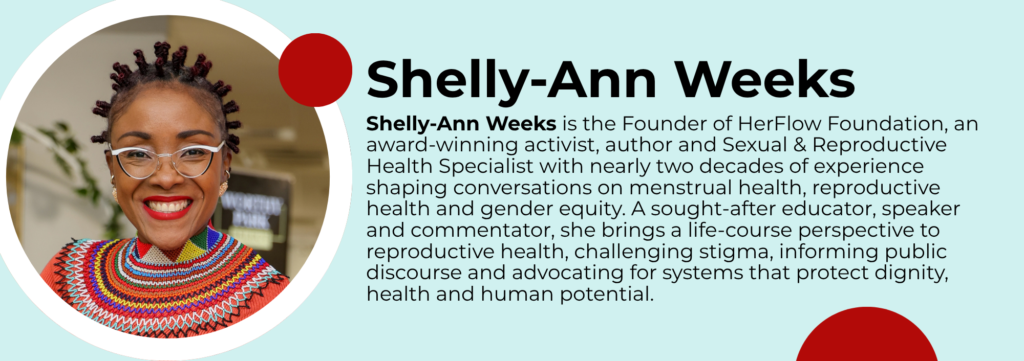
By Shelly-Ann Weeks
Founder, HerFlow Foundation | Sexual & Reproductive Health Specialist
We talk about cramps. We talk about bleeding. We talk about the inconvenience of having a period. But how often do we talk about the anxiety, sadness, irritability and emotional distress that can accompany the menstrual cycle?
For millions of women and girls, menstruation is not simply a physical experience. It is emotional, psychological and social. Yet menstrual health and mental health are still too often treated as separate conversations.
They are not.
A student struggling to concentrate because of severe menstrual pain, a young woman experiencing depression before her period, or a mother worrying about how she will afford menstrual products all demonstrate an important truth: menstrual health and mental wellbeing are deeply connected.
As HerFlow Foundation marks ten years of advocacy, this intersection deserves greater attention. Menstrual dignity is not just about having a pad when you need one. It is also about managing your period without compromising your emotional wellbeing, education, relationships or quality of life.
The Science: Your Cycle and Your Mood
Throughout the menstrual cycle, changing levels of oestrogen and progesterone can influence mood, sleep, energy and emotional wellbeing.
According to the US Office on Women’s Health, as many as three in four women experience symptoms of premenstrual syndrome (PMS) at some point in their lives. These may include mood swings, anxiety, irritability, fatigue and difficulty concentrating.
For some, however, the symptoms are far more severe.
Up to 5% of women of reproductive age experience premenstrual dysphoric disorder (PMDD), a condition characterised by severe emotional symptoms that can disrupt relationships, work, education and daily functioning.
PMDD is not simply having a bad mood before your period. It is a recognised medical condition that can be treated.
Some people with existing mental health conditions also experience worsening symptoms around menstruation, known as premenstrual exacerbation (PME).
The important distinction is whether symptoms are mild and manageable or significantly interfere with everyday life.
Common does not always mean normal, and normal does not mean something you must simply endure.
When Period Pain Affects Mental Health
Imagine preparing for an important examination while experiencing cramps so severe you can barely sit upright. Or trying to remain productive at work after several nights of disrupted sleep because of heavy bleeding and pain.
Now imagine being told this is simply part of being a woman.
A 2023 meta-analysis of 44 studies found that more severe menstrual pain was associated with increased anxiety, depression and psychological distress.
Conditions such as endometriosis, adenomyosis and fibroids may contribute to severe menstrual symptoms and require medical attention.
When pain repeatedly disrupts sleep, education, employment and relationships, the consequences extend beyond the reproductive system.
Pain that prevents someone from participating in everyday life should never be dismissed as simply part of menstruation.
Period Poverty Has an Emotional Cost
At HerFlow Foundation, we have spent a decade confronting period poverty in Jamaican schools and communities.
But period poverty is not simply about the inability to afford menstrual products.
Consider the student who worries about bleeding through her uniform, the young woman who avoids social activities because she cannot afford adequate protection, or the mother forced to choose between menstrual products and other household necessities.
These experiences can create anxiety, embarrassment, isolation and emotional distress.
A 2025 review of 74 studies found associations between menstrual inequity and mental health concerns, including anxiety, distress and depression.
This reinforces something we have long advocated: menstrual equity is also a mental health issue.
Providing products is essential, but we must also provide education, appropriate facilities, supportive environments and access to healthcare without shame or discrimination.
What’s Normal, What’s Not, and When to See a Doctor
One of the most damaging misconceptions about menstruation is that anything associated with a period must be tolerated.
While some symptoms are common, others signal that medical attention may be necessary.
| Symptom | Usually manageable | When to see a doctor |
| Mood changes | Mild irritability or sadness that resolves | Severe anxiety, depression, hopelessness or emotional distress |
| Period pain | Mild cramps relieved by usual treatment | Pain that disrupts school, work or daily activities |
| Bleeding | A flow consistent with your usual pattern | Soaking through products every hour, repeated very heavy bleeding or bleeding between periods |
| Fatigue | Temporary tiredness around menstruation | Persistent exhaustion, dizziness, fainting or breathlessness |
| Cycle changes | Some variation in timing | Periods that stop unexpectedly or become significantly irregular |
| Emotional wellbeing | Temporary mood changes without major disruption | Persistent depression, panic, inability to function or thoughts of self-harm |
Important: Seek urgent medical attention for severe bleeding accompanied by dizziness or fainting, sudden severe pelvic pain, or thoughts of self-harm or suicide.
Seven Ways to Support Your Menstrual and Mental Health
1. Track your cycle and your mood.
Record your periods, pain, sleep, energy and emotional changes for two or three cycles. Patterns can help identify PMS, PMDD or other concerns.
2. Prioritise sleep.
Consistent, adequate sleep can help regulate mood and improve your ability to manage discomfort.
3. Move your body.
Walking, stretching and gentle exercise may help reduce menstrual discomfort and support emotional wellbeing.
4. Manage pain appropriately.
Heat therapy and suitable pain medication may provide relief. Seek medical advice if pain is severe or persistent.
5. Pay attention to nutrition.
Stay hydrated, eat balanced meals and include iron-rich foods, particularly if you experience heavy bleeding. Persistent heavy bleeding requires medical assessment.
6. Talk about what you’re experiencing.
Speak with someone you trust, a counsellor or healthcare professional. You should not have to manage distress in silence.
7. Know when to seek help.
If symptoms interfere with your education, work, relationships or daily activities, consult a healthcare professional. Conditions such as PMDD and severe menstrual pain are treatable.
We Need to Change the Conversation
Schools must recognise that menstrual pain and emotional distress can affect learning. Employers should create supportive environments where menstrual health concerns can be addressed respectfully. Parents must talk openly with their children about both the physical and emotional aspects of menstruation.
And healthcare professionals must listen when patients say their symptoms are affecting their lives.
At Conference. Period. 2026, taking place October 23–24 at the University of Technology, Jamaica, we are bringing these interconnected conversations into the open.
After ten years of working with women, girls and communities, one lesson is clear: we cannot address reproductive health effectively by focusing on the body while ignoring the mind.
We must create a culture where a girl can say, “My period is affecting my mental health,” and be taken seriously. Where women recognise the signs of PMDD and receive appropriate care. And where menstrual health is understood as an essential component of overall wellbeing.
Your period should not cost you your peace of mind. And seeking help should never be a source of shame.
Educate. Empower. End Stigma.