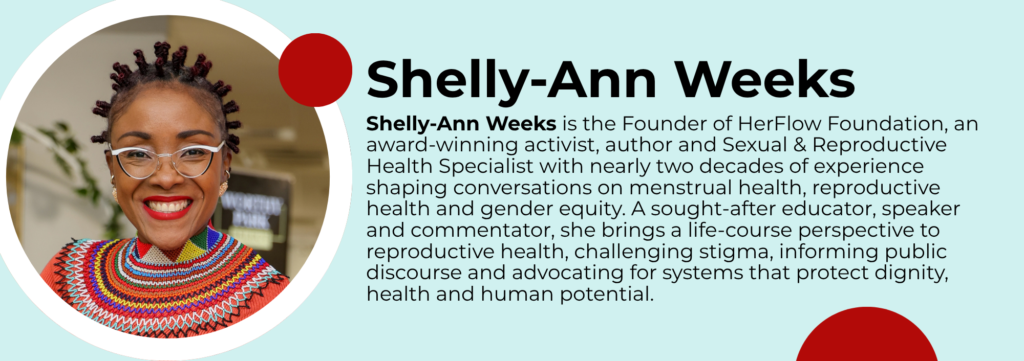
By Shelly-Ann Weeks
Founder, HerFlow Foundation | Sexual & Reproductive Health Specialist
Period poverty is routinely filed under “women/girl’s issues.”
After over a decade on the frontlines, I can definitively say, that while period poverty direct impacts women and girls, they are not the only ones dealing with the consequences of this issue.
When a girl cannot afford a menstrual product, the consequences don’t stop at the bathroom door. She may miss school. She may struggle to participate fully in class. She may experience shame or anxiety. And as she becomes an adult, inadequate menstrual-health support can affect her ability to participate fully in work and everyday life. This affects her ability to support her family, show up fully at work or even function in dignity every day.
UNICEF reports that poverty, stigma, gender inequality and inadequate access to toilets and menstrual products can prevent people from managing menstruation safely and with dignity.
In Jamaica, this is not an abstract problem. HerFlow Foundation has distributed more than 16 million menstrual products since 2016, reaching schools and communities across the island.
But here is what ten years on the frontline has taught me:
Donations are an emergency response to a gap. They cannot be the system sustainably solves the problem.
Sustainable change looks different.
It looks like menstrual products being available in school bathrooms. It looks like safe, private facilities and proper disposal. It means menstrual and reproductive health education that removes the shame that prevents girls from asking for help. It means employers recognizing menstrual health as part of ordinary workplace wellbeing. And it means public policy and procurement systems that make access predictable rather than dependent on who donated this month.
Jamaica has already begun moving in this direction. The National Menstrual Health Equity Initiative, launched in 2026 through a partnership involving government, HerFlow Foundation and UNICEF, will integrate menstrual products and education with WASH, HPV and broader adolescent-health interventions.
Menstrual health is not a private inconvenience. It is a public systems issue.
At Conference. Period., we are bringing students, caregivers, educators and decision-makers into the same room to ask an important question:
What comes after generosity?
CALL TO ACTION: Join us at Conference. Period., October 23–24 at UTech, and be part of the conversation about building systems that make menstrual dignity sustainable—not charitable.