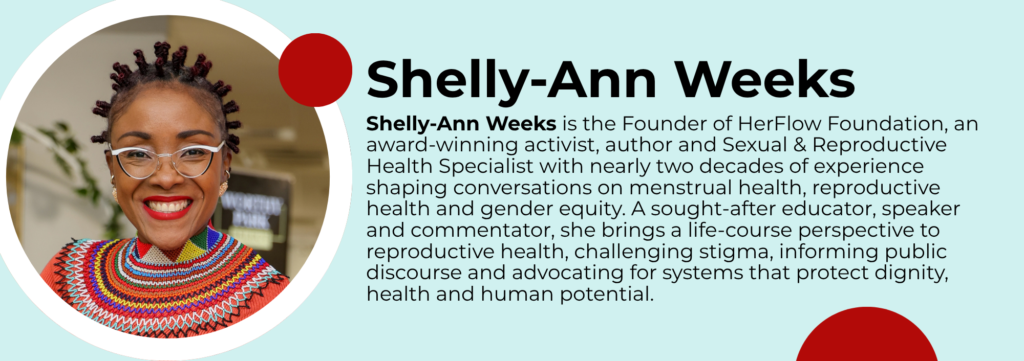
By Shelly-Ann Weeks
Founder, HerFlow Foundation | Sexual & Reproductive Health Specialist
We need to rethink how we talk about puberty.
The popular definition of puberty is “the transition from childhood to adulthood.” While biologically, this definition makes sense, we sometimes forget that the beginning of this important milestone happens to a child, sometimes as young as 7 or 8. Using adultifying language around puberty creates a dangerous misunderstanding: a child has now become an adult.
Adolescence is a distinct stage of development. The World Health Organization defines adolescence as ages 10 to 19, describing it as a period of rapid physical, cognitive and psychosocial growth. At this stage of development, the child is experiencing a physical, mental and emotional transition and it can feel overwhelming. Some parents and caregivers, in their excitement that their child has reached this stage, will say things like “You’re a woman now,”, “Look at the big man” or “Welcome to womanhood”.
While this is done to show support, it is not ideal. Bear in mind that the child has being growing since birth, the unique feature of puberty is that now, they are able to reproduce. Emotional and cognitive development continues along with the obvious physical changes. The child may even start to look older, they still require protection, guidance, reassurance and age-appropriate information.
This is particularly important for girls.
Getting a period does not make a girl a woman. Developing breasts or curves does not make her an adult. Looking older does not mean she is ready for adult expectations.
Puberty changes a child’s body; it does not suddenly make that child an adult. We have to be careful that physical development does not become an excuse to place adult expectations, responsibilities or burdens on children.
This is why reproductive-health education matters before, during and after puberty. Children need to understand what is happening to their bodies, know their boundaries, recognize inappropriate behaviour and know which trusted adults they can turn to.
WHO emphasizes that young people need age-appropriate reproductive-health education, life skills and safe, supportive environments as they navigate adolescence.
Our responsibility is not to rush children into adulthood.
It is to prepare them for growing up while protecting their right to still be children.